Blog

How to talk to someone who experiences a tragedy or serious illness

Friends and family member often struggle when their loved one is experiencing a tragedy or receives a tough medical diagnosis. They want to help, but are not sure what to do. They want to offer words of support, but don’t know what to say. They want to call, but are afraid to be a bother. They worry about saying the wrong thing, doing too much or not doing enough.  

So here are a few Do’s and Don’ts to help you be helpful in life’s difficult moments:

Don’ts

  • Don’t treat the person like a victim. This makes them feel even more like one.
  • Don’t ask them about their mood. This implies an expectation of them being in a bad mood and struggling when they may be managing well.
  • Don’t try to “solve” their problem. Don’t tell them that things will turn out ok or that they will “adjust”. It is not in your power to make this happen and only serves to minimize their problem or invalidate their feelings.
  • Don’t avoid calling because you think you may “disturb” them. If they do not feel like talking, they will not pick up your call. If your calls go unanswered, keep calling.  The call itself lets them know you care.  
  • Don’t be afraid to accidentally “remind” them of their tragedy. They did not forget.
  • Don’t say “call me if you need anything.” Many will not.  If you want to help, ask what would be helpful.  

Do’s

  • Communicate, whether by call, text, or email! Lack of communication from others makes people feel alone in their grief.
  • Ask open ended questions and give them an opportunity to talk.
  • Talk to them the way you always do. Do you usually ask what they are up to? Ask. What’s for lunch, what they are watching or listening to, stock market, workouts? Have a normal conversation.
  • Their personality and needs are in many ways unchanged. Treat them as you normally would.


Avoid Decision Making Paralysis

Imagine yourself at a crossroads. You know where you want to go, but you are not sure which road will lead you there. There are no road signs, so there is no way to tell which path you should choose. Which way should you head?

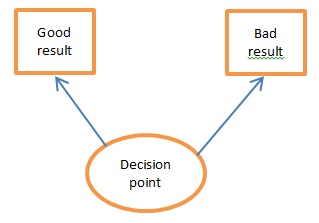
Decisions in complex, uncertain, or unpredictable environments can be very similar to those faced by lost travelers on poorly labeled roads. When stakes are high, uncertainty regarding the best solution can lead to paralyzing anxiety and decision-making avoidance. If you find yourself in such a place, this is probably how you see your choices:

Decision 1.jpg

However, indecision is a decision in itself. It is akin to our traveler deciding to remain at the crossroads. Barring extraordinary circumstances, such as an earthquake moving the destination towards him, this approach guarantees that he will never get to his goal.

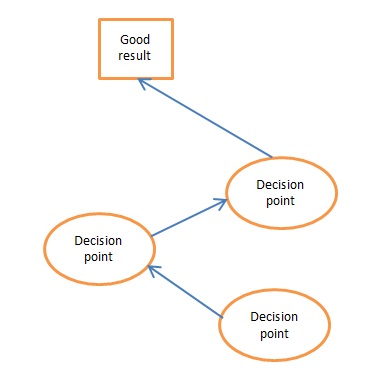
So how can you get over decision-making paralysis? Consider a change in perspective. Ask yourself: am I overvaluing the importance of this decision? If you start in about the right direction, will you move forward while retaining the option to correct your path along the way? Could the movement of the sun during the day or the shine of the North Star at night point our traveler? May he run into someone who knows directions? Consider whether the process of movement in itself could provide opportunities that will help you correct your course. This view re-frames the decision-making process as a series of approximations that will eventually get you to your goal. From this perspective, each new decision is less critical than the single all-important decision in the original schema. Here is a picture that can help you visualize this:

Decision 2.jpg

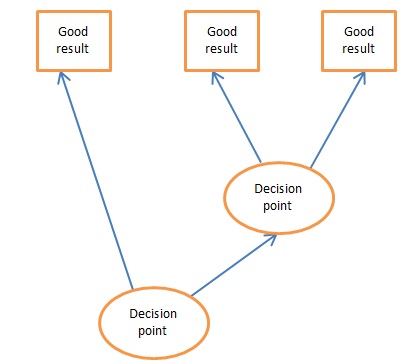
Alternatively, there may also be more than one desired destination. During our traveler’s journey, his skills, surroundings, resources, and travel companions will most likely change. He may get more tired or more energized. He may find that his path was flat and easy or that a long uphill hike wore him out. He may build up his leg muscles and decide to extend the trip, learn to enjoy the solitude and spend time alone in a new place, or change his mind and return home. This view frames the desired outcome as not necessarily predetermined and leaves room for one to re-evaluate his goals along the way. As a result, lesser significance is placed on each decision, making that initial one easier. Here is what this can look like:

Decision 3.jpg

So how do you get over your decision-making paralysis? Just take your first step! It’s better than standing still.

Coaching Company Leaders

According to the 2013 Stanford Graduate School of Business/The Mils Group survey, two-thirds of CEOs and nearly half of senior executives don’t receive coaching. However, near all report that they would be receptive to it.  The top areas where coaching is desired were identified to be conflict management, sharing leadership/delegation, team building, and mentoring. In addition to building specific skills, coaching can help executives function more effectively in their current role and advance their personal development.
 
CEOs have unique needs. Additionally, there are few people available at this level who can offer honest advice or point out the blind spots. This leaves the individual with the most responsibility for the company without candid feedback. As an objective third party devoid of company influences, an external executive coach can provide input that others cannot.

A coaching engagement that meets important conditions of trust, mutual respect, and confidentiality may create the only space where top executives could be totally open and can deal with difficult issues. Regardless of how talented they are, top leaders can still have their share of doubts. The impartiality of an external coach can encourage executives to take a step back for a more objective look at an issue, to verbalize their concerns, and to be supported.

Executive coaches often rely on assessment batteries and 360 feedback to help identify individual’s talents and growing edges. Each instrument comprising the battery is usually selected to identify executive’s characteristics in various domains, such as for example personality or motivation. Such assessment helps the executive and their coach to better understand what personal qualities got them where they are and in which areas they could benefit from further development. When utilizing executive assessment, contracting an external coach has an advantage over utilizing an internal one; an executive can be more open since the assessment data can remain a privy of the coach and the coachee and does not have to be shared with the HR department of the organization.

Executive coaching can assist leaders with more than just helping them to become aware of their strengths and shortcomings. Coaches can help executives practice their learning in the context of their current job while maintaining day-to-day responsibilities and can provide constructive feedback on how their performance changes over time. The top executive’s behavior change is likely to trickle down throughout the organization. It can lead to improvements in company culture, moral, teamwork, and productivity. This can help build a powerful competitive advantage for the overall organization.

Psychological Assessment in the Workplace: Legal Considerations.

Psychological assessment can greatly aid organizations with employee development and selection decisions. Pre-hire assessments can assist with creating a more objective selection process, improve match between candidates’ personalities and organizational needs, reduce ramp up time, and increase job satisfaction and retention. Assessment for leadership development can help to identify employees with high leadership potential and assess key personnel for strengths and developmental needs. For individuals in the upper level positions, assessment can provide data for further development through executive coaching.

The laws that have important implications for psychological assessment in the workplace include Title VII of the Civil Rights Act (CRA), Age Discrimination in Employment Act (ADEA), Title I of the Civil Rights Act, and Americans with Disabilities Act (ADA). These laws prohibit discrimination in employment based on race, religion, sex, sexual or gender orientation, national origin, age, or disability. It is important to note that under disability ADA includes mental illness.

The Equal Employment Opportunity Commission (EEOC) was established to enforce federal laws prohibiting employment discrimination. Along with three other agencies, the EEOC participated in the development of Uniform Guidelines on Employee Selection Procedures. Uniform Guidelines state that it is unlawful to use any test or selection process that creates “adverse impact“, which is said to occur when a substantially different rate of employment decisions work to the disadvantage of members of a protected group. On the other hand, Uniform Guidelines also address “business necessity”, an exclusion that allows Hooters, for example, to avoid having to hire male waiters.

A good test measures what it claims and does so consistently. Two statistical properties of a test, its reliability and validity are very important when making test selection. Properly developed tests should include a manual reporting validity and reliability evidence and the details on how the development and validation studies were conducted. Furthermore, the results of these studies should have been made available to the scrutiny of other professionals via publication in peer reviewed journals. Among other data that should be reported in the manual are the age, sex, and racial composition of the research sample used for the test development.

An assessment battery is a set of instruments selected for a specific assessment purpose (e.g. leadership development). Each instrument typically measures a number of specific individual characteristics (e.g. analytical reasoning). Psychological testing often relies on personality inventories which measure characteristics such as motivation, emotional intelligence, or self-discipline. These constructs should be job-relevant. Personality inventories that measure clinical constructs, such as depression or neuroticism, can be interpreted to violate the ADA.
This is the case even if the construct was not used to draw a conclusion, since it can be claimed to bias the assessor.

It is important to differentiate selection assessments from those performed for development purposes, as the concerns about adverse impact are eliminated when no selection, placement, or training decisions are being made. Furthermore, if the assessment is administered by a third party, the assessment results can be provided to the individual and not the organization, further eliminating the concern that the assessment data could be used for selection at some point in the future.

The professionals who provide individual psychological assessment in organizations must have the training necessary to properly evaluate assessment instruments for compliance with the above laws. To do so, they must possess an understanding of psychometrics, including theory of test development and statistics. They must also be knowledgeable about the specific tests used and be trained in administration procedures. Industrial and organizational psychologists who specialize in assessments should be sought out for the purposes of evaluating, administering, and analyzing the results of assessment measures. For more information on psychological assessment in the workplace, check out Testing and Assessment: an Employer’s Guide to Good Practices published by the US Department of Labor.