
Imagine yourself at a crossroads. You know where you want to go, but you are not sure which road will lead you there. There are no road signs, so there is no way to tell which path you should choose. Which way should you head?
Decisions in complex, uncertain, or unpredictable environments can be very similar to those faced by lost travelers on poorly labeled roads. When stakes are high, uncertainty regarding the best solution can lead to paralyzing anxiety and decision-making avoidance. If you find yourself in such a place, this is probably how you see your choices:

However, indecision is a decision in itself. It is akin to our traveler deciding to remain at the crossroads. Barring extraordinary circumstances, such as an earthquake moving the destination towards him, this approach guarantees that he will never get to his goal.
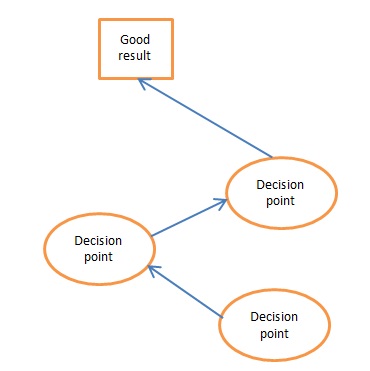
So how can you get over decision-making paralysis? Consider a change in perspective. Ask yourself: am I overvaluing the importance of this decision? If you start in about the right direction, will you move forward while retaining the option to correct your path along the way? Could the movement of the sun during the day or the shine of the North Star at night point our traveler? May he run into someone who knows directions? Consider whether the process of movement in itself could provide opportunities that will help you correct your course. This view re-frames the decision-making process as a series of approximations that will eventually get you to your goal. From this perspective, each new decision is less critical than the single all-important decision in the original schema. Here is a picture that can help you visualize this:
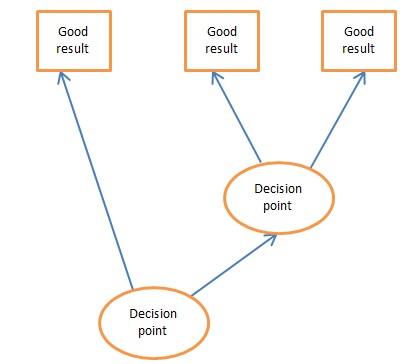
Alternatively, there may also be more than one desired destination. During our traveler’s journey, his skills, surroundings, resources, and travel companions will most likely change. He may get more tired or more energized. He may find that his path was flat and easy or that a long uphill hike wore him out. He may build up his leg muscles and decide to extend the trip, learn to enjoy the solitude and spend time alone in a new place, or change his mind and return home. This view frames the desired outcome as not necessarily predetermined and leaves room for one to re-evaluate his goals along the way. As a result, lesser significance is placed on each decision, making that initial one easier. Here is what this can look like:
So how do you get over your decision-making paralysis? Just take your first step! It’s better than standing still.
 Nora Maidansky, Psy.D., Psychologist